From Extraction to Circulation: Rethinking How Cities Build Wealth
This is the first issue of Building Equity, an intelligence platform at the intersection of capital, cities, and community. If someone forwarded this to you, you can subscribe here. If you are already a subscriber, thank you for being here from the start.
Cities like Gary, Detroit, and Liverpool are often held up as case studies in economic decline. But that framing misses the deeper issue. These places did not simply lose jobs or population. They lost control over how wealth moves through their communities.
Legacy cities, once engines of industrial prosperity, now face a different challenge: rebuilding local economies in ways that are not only resilient, but equitable and regenerative. Traditional redevelopment approaches tend to prioritize growth over ownership. Investment is frequently structured to maximize short-term returns, while long-term value is extracted and redistributed elsewhere. This cycle undermines trust, deepens inequality, and prevents communities from shaping their own futures.
Reversing this pattern requires more than a policy shift. It requires a shift in how we define wealth itself.
Stewardship is a more useful frame than accumulation. It asks not just how much value is created, but who governs it, who benefits from it, and whether it remains rooted in the people and places that produce it. That question, deceptively simple, cuts to the heart of why so many urban investment strategies fail the communities they claim to serve.
This is not a theoretical exercise. It is already underway. In Cleveland, worker-owned cooperatives have helped anchor jobs and profits locally. In Preston, UK, the city demonstrated how municipal procurement can prioritize local businesses and keep public spending circulating within the community. These are practical examples of what it means to shift from extraction to circulation.
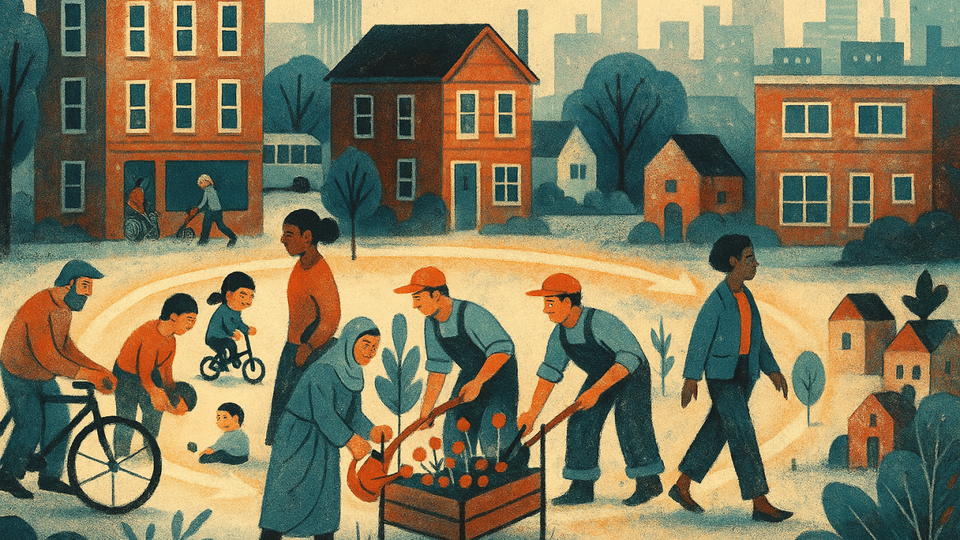
Gary, Indiana, like many mid-sized industrial cities, has the physical and institutional assets necessary to lead this kind of transition. Its infrastructure, location, and civic fabric offer a foundation for what I call the Local Capital Loop, a framework where housing, small business development, and land use are structured for shared returns. In this model, residents, investors, and public institutions collaborate in the governance and ownership of value-generating assets, enabling a more durable and inclusive approach to regeneration.
Globally, cities in transition face similar dynamics. Public-private partnerships must be evaluated not only by their financial outcomes, but by their capacity to build local capacity, trust, and equity. Financial institutions and civic leaders can begin to align capital with stewardship by measuring success through long-term community benefit, not just return on investment.
The future of legacy cities depends on this shift from extraction to circulation. By embedding stewardship into the design of urban finance, governance, and investment, cities can move from recovery to resilience. What emerges is not just economic growth, but economic belonging.
Building Equity publishes twice a month, every other Tuesday. If this issue resonated, consider becoming a Founding Member. There are 100 spots and they will not reopen once they close.